Author: Bramley Money

  • Best business credit cards in the UK (2026): ranked in pounds, not stars

    calculation of real values

    There is no single best business credit card, but there is a best one for your numbers. Ranked by real first-year value at a typical £5,000 a month, paid in full, the current top five among the 15 UK business cards we track are led by Funding Circle’s Cashback Card, and the table below is computed live from checked issuer figures. Change the spend, the spending mix or whether you clear the balance monthly, and the order changes. This page explains how we rank, what the top cards are actually good at, and which questions decide the answer for your business.

    How we rank: value in pounds, not stars

    Most “best card” lists give marks out of five. We add up money instead. For each card: a year of rewards on your spending mix, plus any signup bonus, plus the perks you would genuinely use, minus the annual fee, minus foreign-exchange charges, minus interest if you carry a balance. The result is an estimated first-year value in pounds, and a separate ongoing figure for year two onwards, once intro offers and fee waivers expire.

    Every figure comes from the issuer’s own published pages, with the source and the date we checked it recorded against each number. A weekly automated run re-reads those pages and flags any change for review; the methodology page lists every assumption, including how we value points. Nothing in this ranking is paid placement, and the apply links are direct links to the issuers.

    pay full vs carry balance comparision

    The current top five at £5,000 a month

    [[ranking spend=5000 limit=5]]

    Funding Circle Cashback Card leads on the strength of its intro offer.

    • 2% cashback for the first six months, capped at £2,000 of cashback, then 1% uncapped
    • No annual fee
    • Needs a limited company with 12 months’ trading and £30,000 turnover
    • Rates need reading carefully: “from 14.9%”, with a representative 34.9% APR variable

    BA Amex Accelerating Business is second only if Avios are worth money to you.

    • Earns Avios, valued here at 1p, Head for Points’ working benchmark; the £756 assumes you fly BA and would have paid cash for the seats
    • £250 annual fee
    • Representative 104.9% APR variable, because a £250 fee dominates the regulated calculation on its assumed £1,200 limit; the purchase rate itself is 26.6%

    Amex Business Gold earns Membership Rewards points, strongest on advertising spend.

    • Free in year one, then £195
    • Points valued here at 0.8p, the bottom of Head for Points’ airline benchmark
    • A charge card with an optional pay-over-time facility since January 2026, at a 29.1% purchase rate

    Capital on Tap Free Rewards is the simplest of the five.

    • 1% back, no fee, no FX charges
    • No minimum trading period; limited companies only
    • Rates published as “as low as 13.86% APR variable”, with no representative figure on the page

    Barclaycard Select Cashback pays flat cashback with no bank-account requirement.

    • 1% cashback, but only in months you spend £2,000 or more
    • No annual fee
    • Representative 25.5% APR variable

    A common mistake when choosing a first business card

    One of the easiest mistakes is choosing a card based on its rewards or perks while ignoring how the business will actually use it. A card that looks valuable when the balance is cleared every month can become expensive when interest is charged on a carried balance. Equally, an apparently attractive card may have an eligibility requirement or business-bank-account condition that rules it out before the application stage.

    The useful comparison is therefore not simply the headline reward rate. Look at the total value after fees, the way your business spends, whether you carry a balance, and whether you actually meet the card’s published requirements.

    If you carry a balance, this whole table is wrong

    The ranking above assumes you pay the statement in full. If you don’t, interest becomes the biggest number in the sum and the order changes completely:

    [[ranking spend=5000 payfull=false limit=5]]

    At this spend a carried balance costs more than any card pays back, so the question becomes which loses least, and low purchase rates beat high rewards. Lloyds and Funding Circle publish 14.9% purchase rates, the lowest we track with a representative figure alongside (Lloyds representative 15.95% APR variable; Funding Circle 34.9%). The calculator asks whether you pay in full and switches the ranking accordingly; answer it honestly, because nothing else you tell it matters as much.

    The cards a pounds ranking can’t place

    Honesty about the edges. Moss publishes no pricing, so we can’t rank what we can’t read; it shows in the calculator with its cashback only. Juni is priced in euros and aimed at ecommerce; converting it to sterling would pretend a precision we don’t have. Metro Bank and NatWest/RBS pay cashback only on fuel and EV charging, which our spending mix doesn’t yet model, so they rank on rates alone here and will look better than shown if most of your spend is fuel. When a card is flagged in the results, that flag is the finding.

    How to think about a “best card” ranking

    A ranking can tell you which product produces the highest estimated value under a particular set of assumptions. It cannot know everything an issuer will consider when assessing an application, nor can it know whether you will actually use every perk or redeem every reward at the assumed value.

    That is why the useful question is not simply which card is number one. It is which card is number one for your business. A ranking should make its assumptions visible, show how the result changes when those assumptions change, and let you see the products that lose as well as the one that wins.

    What “best” actually depends on

    Five inputs move the ranking more than everything else combined: monthly spend, where it goes (general, Amazon, advertising, travel), whether you pay in full, the share of spend in foreign currency, and which perks you would genuinely use rather than admire. That’s what the calculator asks, in eight questions. It shows its working for every card, including the ones that lose.

    What we checked. Issuer product pages and summary boxes for all 15 cards, read live on 19, 21 and 22 Aug 2026: Capital on Tap, Funding Circle, Amex (Gold, Platinum, BA), Barclaycard, Santander, Lloyds, Metro Bank, NatWest and RBS, Amazon Business (both cards), Moss and Juni. Point valuations are editorial estimates with named sources, published in full on the methodology page. A weekly automated check re-reads every source page and flags changes for review.

    Ready for your own answer instead of a typical one? Run the card calculator at /cards.
  • 0% and interest-free business credit cards: what actually exists in the UK

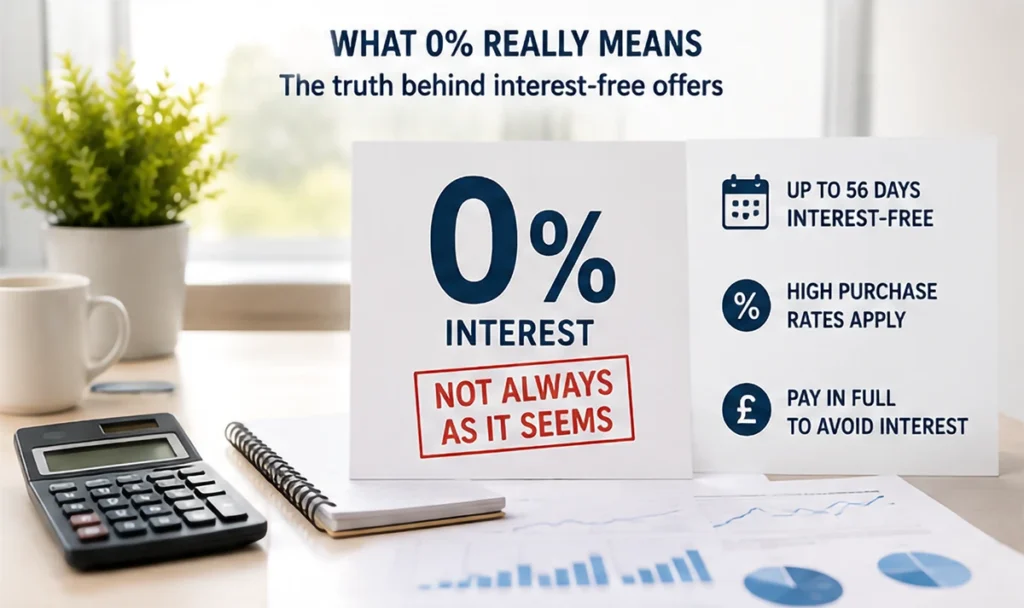
    graphic shows an overview of 0% interest

    If you’re looking for a business credit card with a 0% purchase period, the short answer is that among the 15 UK business cards we track, none publishes one. None publishes a balance-transfer offer either. What every one of them offers instead is the ordinary interest-free window on purchases, usually quoted as “up to 56 days”, and that window does more work than most people realise. This guide explains what it is, what the rates look like when you do carry a balance, and what that balance costs you.

    Why 0% business cards barely exist

    Consumer credit cards compete on 0% periods because the lender expects to make money later, when the promotional rate ends and a share of cardholders keep a balance. Business cards are a different market. Limits are set against the company and usually a director’s personal guarantee, balances are larger, and issuers would rather earn from interchange and annual fees than fund a year of free credit.

    So the offers that do exist on business cards are cashback and points, not 0% interest. Funding Circle’s card pays 2% cashback for six months, capped at £2,000 of cashback, then 1%. Capital on Tap and Amex compete on rewards. The “0%” that turns up in searches is nearly always a US card, where the market works differently.

    For a business, the question behind a search for 0% is often not really about finding a particular card. It is about the cost and length of borrowing. A credit card’s normal interest-free period can provide useful short-term cash-flow flexibility when purchases are paid off in full, but it is not a substitute for longer-term working capital. If a business expects to carry the balance for several months, the purchase rate and the cost of alternative finance matter more than the rewards attached to the card.

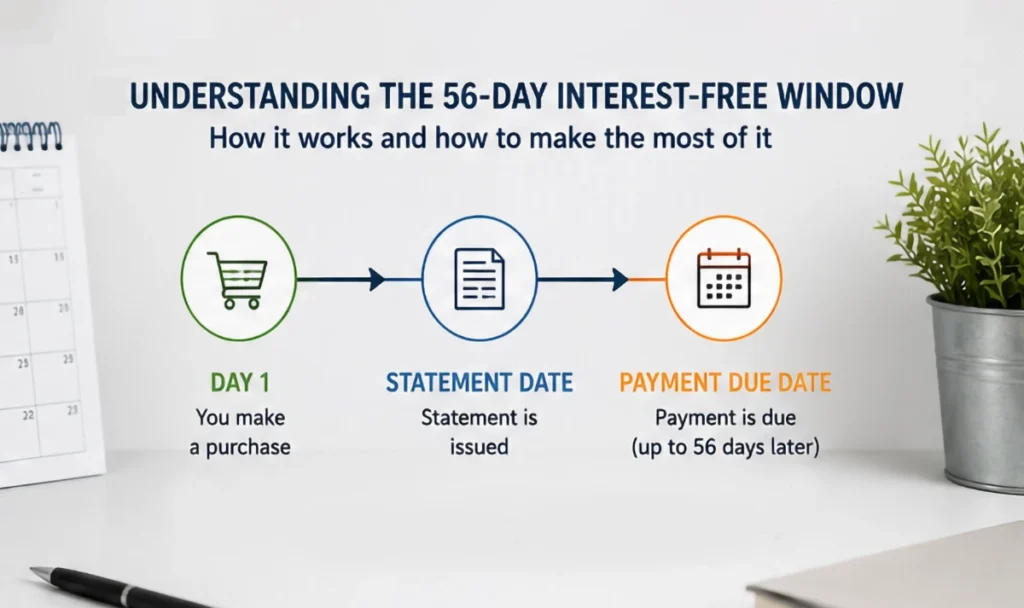
    understanding upto 56 days interest free window

    What “up to 56 days interest-free” means

    Every credit card in our list charges no interest on purchases if you pay the statement in full by the due date. The “up to 56 days” is the longest gap you can get between a purchase and the payment date: buy on the first day of a statement period, get the statement at the end of the month, pay up to 25 or so days later.

    Two things follow. First, the average purchase gets roughly half that, not 56 days. Second, it is interest-free only while you clear the balance every month. Pay even part of it late and interest is charged on the whole balance from the transaction date, at the card’s purchase rate. That is the rate the rest of this guide is about.

    Lloyds and the NatWest and RBS card are the two we have sourced a published 56-day maximum for; the rest describe the same arrangement without putting a number on the longest case.

    Amex’s Business Gold and Business Platinum are charge cards, where paying in full each month was the condition of holding one. Since January 2026 both carry an optional pay-over-time facility, and both publish a 29.1% purchase rate on it. The BA Amex business card is an ordinary credit card, at 26.6%.

    Purchase rate and representative APR are different numbers

    This is where business card marketing is at its least helpful. Issuers publish two rates, and they are not interchangeable.

    The purchase rate is the interest actually charged on a carried balance. The representative APR is the regulated headline: it includes the annual fee, assumes a £1,200 credit limit, and is the rate at least 51% of accepted applicants must get. For a card with no fee the two are close, and Barclaycard’s are identical at 25.5%. For a card with a fee they can be wildly apart: BA’s Amex business card has a purchase rate of 26.6% and a representative APR of 104.9%, because £250 a year against a £1,200 limit dominates the calculation.

    A fee is not the only thing that separates them. Funding Circle charges nothing a year and publishes “rates from 14.9%” alongside a representative 34.9% APR. The 14.9% is the floor. The 34.9% is what most accepted applicants get or better, and it is more than double the number in the headline.

    Some issuers publish no representative figure at all. Capital on Tap’s “rates as low as 13.86% APR” is a floor with nothing published next to it. We show a “from” rate as exactly that, in the table below and on every card in the calculator.

    [[rates]]

    What a “from” rate actually means

    A rate advertised as “from 14.9%” is the lowest rate available, not necessarily the rate most applicants will receive. The actual rate offered can depend on the business’s financial position, trading history, credit profile and the lender’s assessment of risk.

    Advertised figure
    What it means
    “From 14.9%”
    The lowest rate available to qualifying applicants
    Your offered rate
    The rate the lender decides to offer your business after its assessment
    Representative APR
    A regulated figure showing the rate that at least 51% of accepted applicants are expected to receive or beat, where the issuer publishes one

    For a business comparing cards, the important distinction is that a “from” rate should not be treated as a promise. If you expect to carry a balance, compare the realistic rate you may be offered rather than assuming you will qualify for the lowest advertised figure. A card with an attractive headline rate can become significantly more expensive if your actual rate is higher.

    The lowest business credit card interest rates

    If you carry a balance, rewards stop being the thing that matters. Here is the calculator’s carry-a-balance mode at £5,000 a month, with about one month’s spend carried and interest charged at each card’s purchase rate:

    [[ranking spend=5000 payfull=false limit=8]]

    Look at the minus signs. One card is ahead after a year, and only because of an introductory offer: Funding Circle’s 2% for the first six months roughly covers the interest it charges over the same period. Its ongoing line is negative like all the others. At this spend, a carried balance costs more than any of these cards pay back, and the question is which loses least.

    On rate alone, the order is:

    • Capital on Tap, “as low as 13.86%”, with no representative figure published
    • Lloyds at 14.9% (representative 15.95% APR variable, the closest thing here to an honest headline)
    • Funding Circle at 14.9%, but a “from” rate with a representative 34.9% APR variable
    • NatWest and RBS at 16.9% (representative 24.3% APR variable)
    • Metro Bank at 17.44% (18.9% APR, and Metro says every customer pays the same rate)

    Access is the catch. Lloyds and Metro each need one of their own business current accounts, and Funding Circle wants a limited company with 12 months’ trading and £30,000 turnover.

    NatWest, RBS and Metro sit low in the table above rather than high, despite those rates. Their cashback is paid on fuel and EV charging only, which the calculator does not yet model, so they earn nothing in the default spend mix and carry the interest cost alone. If most of your spend is fuel, they will do better for you than the table shows.

    If you need to borrow for longer than a month

    A credit card at 14.9% is an expensive way to borrow for a year. If the real need is working capital rather than a payment tool, the honest answer is a business overdraft or loan, which we don’t compare and don’t link to. Use a card for what the interest-free window is good at: a month or two of float on purchases you’d be making anyway, paid off in full.

    The calculator asks whether you usually pay in full. Answer it honestly. It switches the ranking to lowest cost if you say no, and that single answer changes which card wins more than anything else you tell it.

    What we checked. Issuer product pages and summary boxes for all 15 cards, read live on 19, 21 and 22 Aug 2026: Santander, Lloyds, Metro Bank (including its Feb 2024 Important Information Summary), NatWest and RBS, Barclaycard, Funding Circle, Capital on Tap, Amex (Gold, Platinum, BA), Amazon Business (both cards), Moss and Juni. Every card had at least one figure we corrected: Funding Circle’s representative 34.9% and Amex Platinum’s 29.1% pay-over-time rate were both sourced on 22 Aug 2026. The working is in our verification notes on /methodology.

    Ready to see your own ranking? Run the card calculator at /cards.